Excerpt from the D·I·R® YEARBOOK 2025 · Special Edition
For couples with an unfulfilled desire to have children, patients, the public
YEARS 2024/2025
SPECIAL TOPICReproCheckDear readers,
We are pleased to make this special edition available to you as an excerpt from the large 2025 yearbook of the German IVF Register (D·I·R)®. It is aimed at all couples with unwanted childlessness, at all couples who are currently undergoing fertility treatment and also at the general public.
This special edition contains the most important nationwide figures for fertility treatments in the member centers of the German IVF Register. Here you will find the cycle outcomes of 2025 and the pregnancy outcomes of the treatment cycles of 2024.
Contents of this special edition
For one in six couples, the path to having the child they want is not possible naturally, but requires medical help. The German IVF Register (D·I·R)® always provides up-to-date figures, data and the results of fertility treatments in Germany by continuously evaluating treatment data from fertility centers.
Once a year, the D·I·R® publishes its large and comprehensive yearbook. This is aimed both at the public and at reproductive medicine and biologists. It therefore serves the experts for their own quality control, the exchange of experiences and the visualization of trends and improvements. In this special edition we have summarized, explained and commented on the most important key data and currently important topics especially for couples and the general public.
About the German IVF Register (D·I·R)®
The public wants information and transparency with regard to diagnostics and treatments in the sensitive area of fertility medicine. This can only be achieved with a reliable and continuous evaluation of the treatment results from as many fertility centers as possible, such as the German IVF Register. In addition, this evaluation serves to provide scientific knowledge and the associated improvements in medical care and outcomes. But the evaluations of the German IVF Register are also important when it comes to advising and ultimately making decisions for couples who are involuntarily childless.
The German IVF Register (D·I·R)® is a non-profit association. This is a voluntary membership to which almost all fertility centers in Germany are affiliated and which therefore support and support our scientific evaluations, our research and the exchange of experiences. By evaluating the treatments and their results, the D·I·R® represents a unique treasure trove of data, which now contains almost 2.8 million treatments / almost 460,000 children born in Germany.
We would be pleased to have put together interesting and worth-knowing information for you in this special edition of the 2025 yearbook of the German IVF Register (D·I·R)®.
Your D·I·R® Board
Jan-Steffen Krüssel
Andreas Tandler-Schneider
(Chairman of the Board)
Sascha Tauchert
Table of contents
- Foreword2
- New! ReproCheck from D·I·R®, the original: Calculate your chances yourself3
- Insert one or two embryos? – New findings from the German IVF registry4
- Special topic: AMH value and chances of pregnancy5
- Special topic: Freezing eggs and embryos young6
- Treatments 2024 and 20257
- In a nutshell – The years 2024 and 2025 in the German IVF Register (D·I·R)®8
- Brief overview of the most important results for the public9
- Pregnancy rates and pregnancy outcomes depending on the age of the woman 202410
- Cumulative pregnancies 2020–202411
- Children born 1997–202412
- Mitgliedszentren des Deutschen IVF-Registers13
- Authors, responsible persons, imprint14
- Häufige Fragenonline
- Glossaronline
The complete D·I·R® yearbook 2025 can be found here: www.deutsches-ivf-register.de/jahrbuch.php
NEWReproCheck from D·I·R®, the original: Calculate your chances yourself
The online calculator ReproCheck from the German IVF Register (D·I·R)®, launched in May 2026, enables couples to independently assess their individual chances of success in pregnancy and birth based on high-quality registry data.
ReproCheck: Individual forecasts at the touch of a button! “What are my chances?” – a common and central question about fertility treatment. The ReproCheck enables people who want to have children to get an initial but realistic picture of their individual prospects for success using simple input. Age, previous history and possible type of treatment are enough to better understand your own chances of pregnancy and birth as part of fertility treatment with just a few clicks.
The ReproCheck is aimed at couples before and during treatment. However, it cannot replace medical advice: the starting point for treating an unfulfilled desire to have children - and thus also the chances of pregnancy and birth - is always too individual and too dependent on the respective patient and the couple to be able to be shown in the ReproCheck. But it strengthens informed decision-making at a sensitive time in life. For many affected people, the ReproCheck offers valuable orientation in an emotionally challenging phase of life. It helps to classify expectations, prepare for discussions with treating doctors and make individual decisions more informed and together. The ReproCheck chances calculator does not replace medical advice, but is intended as a supplementary information offering.
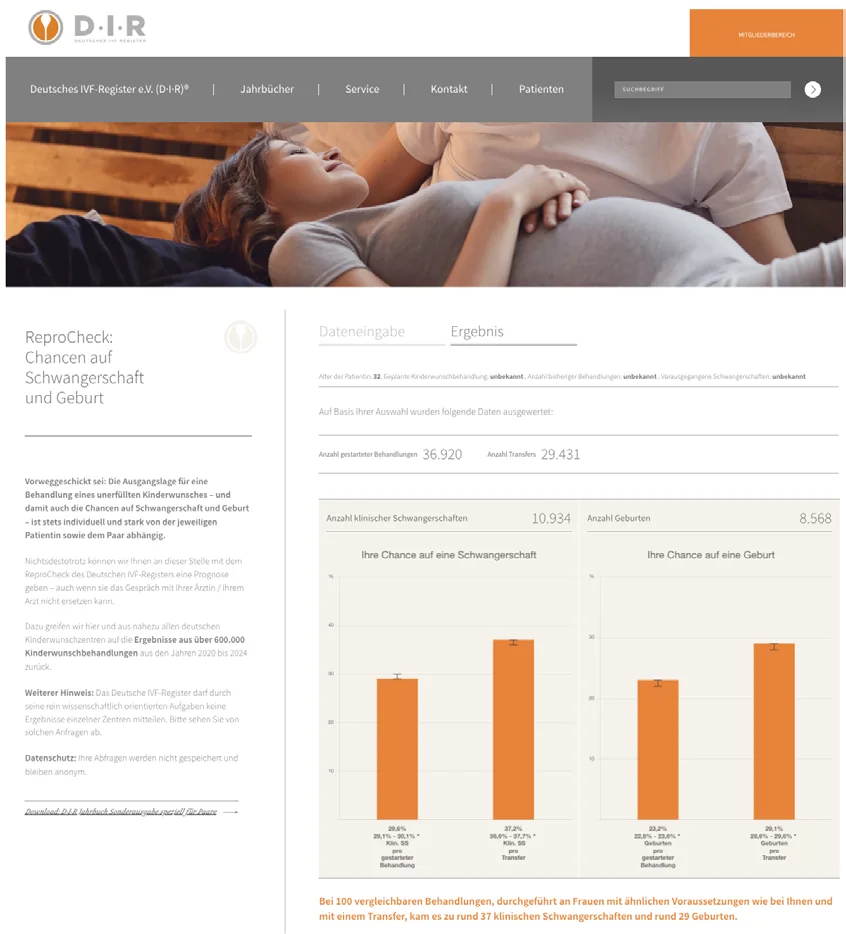

The significance of the ReproCheck is based on an exceptionally high-quality data basis. Over 600,000 treatments from 2020 to 2024, recorded in almost all German fertility centers, are included in the calculations. This systematically collected and quality-assured registry data is reliable and representative of the actual supply situation in Germany. The ReproCheck gives couples a tool with which they can, for the first time, assess their chances realistically and on a scientific basis. Its strength lies in the quality and breadth of the data from the German IVF Register; they make the results reliable and relevant to everyday life.
More clarity when it comes to your desire to have children
A typical example shows what this can look like: A 35-year-old woman who is planning IVF treatment receives a differentiated assessment of her chances of pregnancy and birth, including the range of possible outcomes, based on comparable cases. Because: Especially for patients in their mid-30s, it is important to understand how individual factors affect the chances of success - or how the chances would gradually worsen if they waited a few more years of life. The ReproCheck can help to adjust expectations and to have more targeted conversations with doctors.
The ReproCheck is freely accessible, free of charge and user-friendly. Clear structures and understandable representations also make access easier for medical laypeople. Complex content is prepared in a comprehensible manner. The queries are not saved and always remain anonymous.
With this offer, the German IVF Register is providing an important impetus for more transparency and patient orientation in reproductive medicine - and is already developing the next generation!
To the ReproCheck – calculate your chances yourselfInsert one or two embryos? – New findings from the German IVF registry
Many couples hope to increase their chances of becoming pregnant when IVF treatment involves placing two embryos into the uterus at the same time. The rationale behind this is that if two embryos are transferred, there is a greater chance that at least one will implant. At the same time, however, the risk that both embryos will develop and a twin pregnancy will occur also increases. This very question has now been examined in more detail using data from the German IVF Register (D·I·R)®. In addition, the results were classified in an accompanying editorial by Prof. Heribert Kentenich.
For the study, data from more than 22,000 women who were treated in 133 German fertility centers between 2017 and 2022 were evaluated. Only women who had two well-developed blastocysts available on the day of embryo transfer were included. Two different treatment strategies were compared: either both embryos were transferred at the same time (double embryo transfer, DET) or only one embryo was inserted initially and - if no birth resulted - the second, previously frozen embryo was transferred at a later point in time (two consecutive single embryo transfers, SET + SET).
The results first show that a pregnancy is slightly more likely to occur immediately after a simultaneous transfer of two embryos than after a single embryo transfer. However, when considering the entire treatment including the subsequent transfer of the frozen embryo, slightly more women achieved a live birth after two consecutive single transfers than after a single transfer of two embryos. In other words, patience can pay off.
The most important difference, however, was in the safety of mother and child. After the transfer of two embryos, twin pregnancies occurred significantly more frequently. About every third birth after a double embryo transfer was a multiple birth, while this only happened very rarely after two consecutive single transfers. However, twin pregnancies are associated with significantly higher risks. The children are much more likely to be born prematurely, have a lower weight at birth and more often require intensive medical care. The risk of pregnancy complications such as high blood pressure or preeclampsia also increases for the mother. Exactly these differences were impressively confirmed in the registry analysis: premature births occurred more than twice as often after the transfer of two embryos as after two individual transfers.
In the accompanying editorial, Prof. Kentenich therefore emphasizes that the goal of modern fertility treatment should not only be pregnancy, but above all the birth of a healthy child. The study shows that this goal can often be achieved better if only one embryo is transferred at a time. At the same time, he points out that the legal framework in Germany has not always optimally supported this strategy and should therefore be further developed.
The results of this large registry study make it clear that a single embryo transfer with the possibility of a later transfer of the frozen second embryo can be a very good option for many couples. The chances of having a healthy child remain high, while the risk of twin pregnancies and associated complications decreases significantly. For many couples, this means that the common goal of fertility treatment should not be the fastest pregnancy, but rather the safest birth.
SET + SET versus DET: Key figures in comparison
- DET (two embryos at once)
- SET or SET + SET
Special topic: AMH value and chances of pregnancy
Short version for patients, couples and the public
The higher the AMH level, the better the chances of pregnancy. But even if the value is very low, around one in five women will still become pregnant after an embryo transfer.
What this is about
The anti-Müllerian hormone (AMH) is measured in the blood. It shows how many eggs are still available in the ovaries (the so-called egg reserve). Doctors use the value to assess the chances of success of fertility treatment and to plan hormonal stimulation. The D·I·R® evaluated almost 110,000 treatments with egg collection from the years 2024 and 2025; 83,849 of these had an AMH value.
Pregnancies per embryo transfer according to AMH value
- AMH level in ng/ml
- Average of all women (30.8%)
Clinical pregnancy = pregnancy confirmed by ultrasound. Fresh cycles 2024 and 2025.
As the AMH value decreases, fewer eggs are recovered: on average 2.5 at the lowest value and 11.6 at the highest. At the lowest value, embryo transfer only occurs in 69% of treatments, compared to 87% on average for all women. Women with low AMH levels were on average older (around 38 years) than women with high levels (around 33 years).
Low AMH levels: Age makes the difference
Women with an AMH value below 1 ng/ml were also considered by age. Pregnancies per embryo transfer:
Look it up: Select age and AMH value
| Age | AMH under 0.25 | AMH 0.25 to 0.50 | AMH over 0.50 to 0.99 |
|---|---|---|---|
| under 30 years | 22 % | 34 % | 35 % |
| 30 to 34 years | 28 % | 31 % | 34 % |
| 35 to 39 years | 25 % | 26 % | 27 % |
| 40 years and older | 11 % | 13 % | 16 % |
Up to your mid-30s, your chances are quite good, even with a low AMH value. From the age of 40 onwards they drop significantly, but even at the lowest value they are still around 11% per transfer. The youngest women with very low scores had few treatments; these numbers are more uncertain.
What this means for you
- A low AMH value is not a reason for exclusion from fertility treatment. Above all, it means: fewer eggs and more often no embryo transfer.
- Age plays at least as important a role as the AMH value.
- The numbers are averages. It is best to discuss your personal chances at your fertility center.
Limitation: Laboratories measure AMH levels using different methods; the values are therefore not exactly comparable. The numbers are average values and do not replace personal advice in the fertility center.
Source: D·I·R® Yearbook 2025, special evaluation “Results in fresh cycles according to patient age and AMH values”, pp. 13–14 (Dr. med. Andreas Tandler-Schneider, Prof. Dr. med. Jan-Steffen Krüssel, Dr. med. Sascha Tauchert).
Special topic: Freezing eggs and embryos young
Short version for patients, couples and the public
Anyone who freezes eggs or embryos at a younger age and uses them later has a significantly better chance of having a child in their mid-30s than if they were treated at an older age.
What this is about
As a woman ages, the chances of receiving treatment decrease and the effort required to give birth to a child increases significantly. On average, the following are mathematically necessary:
Effort until the birth of a child
- Treatments with hormone stimulation
- Embryo transfers
Show as table
| Age | Treatments with hormone stimulation | Embryo transfers |
|---|---|---|
| ≤ 34 years | about 4.5 | about 3.3 |
| 35 to 39 years | 6,5 | 4,6 |
| 41 years | 14,2 | 9,3 |
| 43 years | 34,7 | 20,8 |
The D·I·R® has therefore investigated for the first time how successful treatments are with embryos that were obtained and frozen at a younger age. Basis: over 430,000 embryo transfers from 2020 to 2024.
Births per embryo transfer
- Fresh cycle (eggs collected in the same cycle)
- Embryos frozen at 30-34 years old
- Embryos frozen at 35-39 years
The difference is particularly large after the age of 40: with embryos from a younger age, a transfer ends in birth two to three times as often. Miscarriages are also rarer: from the age of 40 onwards, 43% of pregnancies in the fresh cycle end in miscarriage, with embryos from the age of 30 to 34 only 19%. Example: A 39-year-old has a 16.8% chance of birth per transfer in the fresh cycle, and 27.7% with embryos from her 31st year. Under 35 years of age the difference is small because the chances in the fresh cycle are still high.
Miscarriages after 40 – fresh cycle
of pregnancies
Miscarriages from 40 - embryos from 30-34 years.
of pregnancies
Example: 39-year-old, chance of birth per transfer
Fresh cycle → embryos from the 31st year of life
Long storage and unfertilized eggs
Long storage does no harm. Even after an average of around 3.7 years in frozen storage, the advantage remains: women aged 40 and over with embryos aged 30 to 34 achieved 29% births per transfer, compared to 9% in the fresh cycle.
For example, in precautionary egg cryopreservation (“social freezing”), unfertilized eggs are frozen and only fertilized after they are thawed. The success rates here are currently even lower. There is still an advantage from the age of 40: 21% births per transfer with eggs from the age of 30 to 34 compared to 9% in the fresh cycle. However, these numbers are based on only a few hundred treatments.
What this means for you
- The most important factor for the chances is the age at which the eggs were collected.
- If additional fertilized eggs or embryos remain during treatment, it is worth freezing them.
- Before you have frozen embryos discarded, remember: This reduces the chances of having a future or additional child.
Limitations: Women who use embryos from younger ages are, on average, slightly younger when transferred than the comparison group in the fresh cycle. There are still too few cases to compare women of exactly the same age. The numbers are average values and do not replace personal advice in the fertility center.
Source: D·I·R® Yearbook 2025, special evaluation “Cryopreservation in young years”, pp. 15–17 (Dr. med. Sylvia Bartnitzky, Dr. med. Ute Czeromin, Dr. med. Andreas Tandler-Schneider, Prof. Dr. med. Jan-Steffen Krüssel, Dr. med. Sascha Tauchert).
Treatments 2024 and 2025
Deadline for data: April 28, 2026
Member centers of the German IVF Register 2025
Register participant D·I·R® Yearbook 2025
Yearbook 2024: 139−1
Documented treatment cycles 2025
2024: 134.281+4,2 %
Number of women treated in 2025
2024: 68.890+4,0 %
Treatment cycles/woman (mean value) 2025
2024: 1,9
In a nutshell – The years 2024 and 2025 in the German IVF Register (D·I·R)®
138 von 141 Mitgliedszentren des Deutschen IVF-Registers exportierten ihre Daten aus den Jahren 2024 und 2025 zum Stichtag. Ein neues Zentrum war noch zu jung, um integriert werden zu können, in Kooperation mit zwei Zentren konnte der Export nicht rechtzeitig fertiggestellt werden. Die Anzahl der plausiblen Behandlungszyklen lag 2025 bei 136.770 Zyklen. Eine Behandlung zur Eizell-Entnahme startete in 61,1 % der Zyklen, der Anteil an Behandlungszyklen mit zuvor eingefrorenen Eizellen betrug 38,9 %. Der Anteil an Kryozyklen war damit weiterhin steigend.
Erfolgsraten: Frisch- und Kryozyklen gleichauf
Die Schwangerschaftsrate pro Embryotransfer im Frischzyklus lag im Jahr 2025 bei 30,2 %, im Kryozyklus lag diese pro Embryotransfer bei 31,5 %. Die Geburtenraten pro Embryotransfer betrugen 2024 im Frischzyklus 22,3 %, im Kryozyklus 22,7 %.
Despite the increasing popularity of the transfer of often only one embryo (single embryo transfer) to avoid high-grade multiple pregnancies, the increase in the pregnancy rate in cryocycles is particularly noteworthy. In 2017 the pregnancy rate per embryo transfer was 26.2% and in 2025 it was 31.5%.
Schwangerschaften pro Embryotransfer 2025
Geburten pro Embryotransfer 2024
Kryozyklen: Schwangerschaften pro Transfer
Das Alter entscheidet
What is noteworthy is the age dependence of pregnancy and birth rates (fresh and thawing cycles together). If women in the age group of 30-34 years can expect a pregnancy chance of 39.0% and a birth rate of 31.1% per embryo transfer, in the age group of 41-44 years the pregnancy rate per embryo transfer drops to 16.9% and the birth rate falls to 8.9%.
Pro Embryotransfer, Frisch- und Auftauzyklen
Schwangerschaften
Geburten
Deutlich weniger Mehrlinge – dank Single-Embryo-Transfer
The continued decline in multiple births is encouraging. Between 2017 and 2024, they were reduced by 15.3 percentage points in fresh cycles and by a good 10 percentage points in thawing cycles! The multiple birth rate in 2024 was 6.7% in fresh cycles and 5.1% in cryocycles - in 2017 it was 22.0% in fresh cycles and 15.4% in cryocycles.
Single embryo transfer is increasingly being used in all treatment cycles in which the prognosis for a successful course of treatment is good. Although the pregnancy rates are slightly lower when a single embryo is transferred despite a good prognosis, the multiple birth rates increase dramatically when two embryos are transferred in this patient group, and with them the rate of pregnancy complications and premature births.
Mehrlingsrate 2017 → 2024
Einfrieren lohnt sich
What is significant is the cumulative birth rate after several transfers after only one egg collection if the chance for cryopreservation existed and was used. After just one fresh transfer and two cryotransfers, more than half of couples can look forward to the birth of a child, even though only one fresh treatment cycle was carried out.
Sicherheit für Mutter und Kind
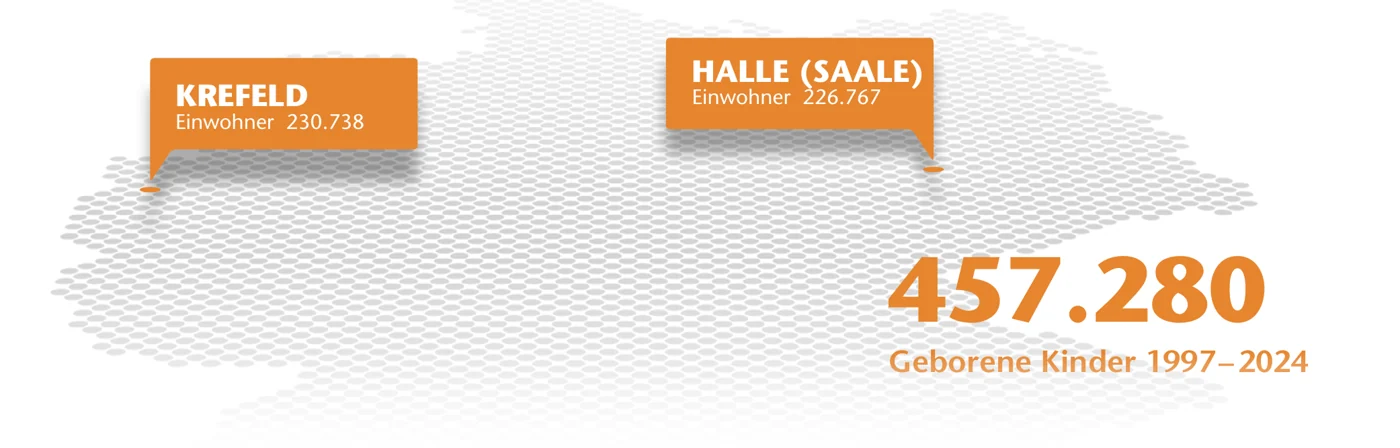
Inzwischen wurden 457.280 Kinder nach In-vitro-Fertilisationszyklen geboren. Dies entspricht den summierten Einwohnerzahlen der beiden Städte Krefeld und Halle (Saale). Der Anteil der Frühgeburten (Geburt vor Ende der 37. SSW) bei Einlingen lag im Jahr 2024 bei 17,0 %, bei Zwillingen bei 87,8 %, bei Drillingen bei 100 %!
Reproductive medicine techniques are safe - the risk of overstimulation as a result of hormone therapy was 0.3%, complications of egg retrieval such as: B. Bleeding was 0.6%.
Frühgeburten 2024 (vor Ende der 37. SSW)
Risiken der Behandlung
Our recommendations if you have an unfulfilled desire to have children:
- Stay confident! Get advice from a fertility center and then decide. Choose a center that is a member of D·I·R® and makes these yearbooks possible.
- Do not wait too long: The chances of successful treatment depend on age.
- Take advantage of the advantages of single embryo transfer, blastocyst culture and cryopreservation. These strategies maximize safety while maintaining cumulative success rates. Cryopreservation ensures that no viable embryo is lost and offers - with comparatively little effort - additional chances of pregnancy for a first, second or even third child.
Brief overview of the most important results for the public
This year we will once again show the most important results in a brief overview on the next few pages. The first evaluation shows the results of the treatments carried out from 2024 up to the birth. The second evaluation Page 10 shows the age-dependent development of both the pregnancy rate per embryo transfer and the births and abortions (miscarriages). The third page (Page 11), we focus on the cumulative pregnancy rate per embryo transfer. This applies regardless of whether it is a fresh embryo transfer or a thawing cycle. The cumulative pregnancy rate is over 70% after four transfers.
Summary of the short statistics 2024 – As of April 28, 2026
for IVF, ICSI and IVF/ICSI – prospective and retrospective data
Outcome of clinical pregnancies
Birth rate per transfer
Shares of multiple births
In 2024, 66,742 fresh cycles to obtain eggs and treat them were carried out in Germany. That's 140 cycles more than 2023.
An embryo transfer with a known cycle outcome occurred in 79.3% of cases.
The birth rate per transfer in 2024 was 22.3%, almost identical to 2023, while the multiple birth rate continued to fall significantly. This can be seen as a success of the single embryo transfer strategy.
While there were 1,017 twin births in 2023 (9.1%), this number fell to 727 twin births in 2024 (6.6% of all births)!
93.2% of births are now singleton births. Even though the multiple birth rate has fallen significantly at 6.7% overall, it is still slightly higher in a European comparison. Scandinavian countries and the Netherlands have multiple births in the natural range of less than 5%. Nevertheless, in Germany we are pleased about the sharply falling trend towards multiple births with their increased risk of premature birth of over 80%.
Pregnancy rates and pregnancy outcomes depending on the age of the woman 2024
Prospective data IVF, ICSI, IVF/ICSI 2024
IVF, ICSI, IVF/ICSI 2024 according to the woman's age
Pregnancy, abortion and birth rates: The 95% confidence intervals shown (gray box or error bars) show how accurately the respective rate can be estimated based on the available data.
Show all values as a table
| Age in years | Embryo transfers (n) | Clinical SS (n) | Clinical SS/ET (%) 95% CI | abortions | Abortions/clinical SS (%) 95% CI | births | Births/ET (%) 95% CI |
|---|
In this graphic we show the development of the pregnancy rate, the birth rate and the abortion rate depending on age. The statistics refer exclusively to fresh cycles and combine IVF and ICSI. Pregnancy and birth rates are calculated per embryo transfer.
Until the age of 31, the pregnancy rate remains above 39%. Births, in turn, are over 25% per embryo transfer up to the age of 35. From our point of view, this is very important for advice and the assessment of the respective opportunities.
Miscarriages (abortions) should also be taken into account in the consultation based on age: while they are significantly less than 20% per pregnancy in women up to the age of 35, they rise to 37.1% at the age of 40 and even rise to over 66% in patients aged 45 and over.
For example, a 35-year-old patient has a pregnancy rate of 35.2% and a birth rate of 27.2%.
From the age of 40 onwards, pregnancy and birth rates drop significantly every year. Every year of life has a big influence here. Patients 45 or older had only 21 pregnancies (4.7%) after a total of 455 transfers and only six births (1.3% per transfer) were documented in this age group in all of 2024!
When it comes to advice, it is therefore extremely important that the fertility treatment should take place promptly, especially in the group of patients aged 35 and over, which is where most of our patients are.
Cumulative pregnancies 2020–2024
Prospective data
Cumulative pregnancy rates
Tap a bar| 2020-2024 total | Number of transfers in fresh cycles | Clinical SS fresh cycles | Clinical SS/ET fresh cycles in % | Number of transfers in cryocycles | Clinical SS Cryocycles | Clinical SS/ET cryocycles in % | Kum. clinical SS | Cumulative pregnancy rates in % |
|---|---|---|---|---|---|---|---|---|
| 1st transfer | 130.660 | 44.051 | 33,7 | 28.993 | 10.129 | 34,9 | 54.180 | 33,9 |
| 2nd transfer | 43.275 | 12.747 | 29,5 | 58.697 | 18.733 | 31,9 | 85.660 | 53,7 |
| 3rd transfer | 23.903 | 6.892 | 28,8 | 35.670 | 11.034 | 30,9 | 103.586 | 64,9 |
| 4th transfer | 12.480 | 3.536 | 28,3 | 20.335 | 5.928 | 29,2 | 113.050 | 70,8 |
| more than 4 transfers | 14.031 | 3.596 | 25,6 | 26.462 | 7.015 | 26,5 | 123.661 | 77,5 |
Follow-up of clinical pregnancies until December 31, 2025. No distinction was made here as to the order in which a patient underwent fresh or thawing cycles from the second transfer onwards.
Important for advice and assessment of the chances is not only the pregnancy and birth rate per treatment or per embryo transfer, but also the pregnancy rate over several cycles. This is particularly true in the era of single-embryo transfer and the improved results of freezing via vitrification.
For these reasons, we calculated pregnancy rates per transfer cumulatively, regardless of whether it was a second fresh cycle or a thawing (cryotransfer) cycle.
After just two embryo transfers, 53.7% of our patients are pregnant. After three transfers this is more than six out of ten and after four transfers this is already more than two thirds of all fertility patients.
Also included in this consideration are the cycles in which the first embryo transfer did not take place fresh, but after thawing. This, for example, if an embryo transfer in the fresh cycle could not be carried out for medical reasons. At least 28,993 first embryo transfers took place after thawing. The pregnancy rate was even slightly higher than in the fresh cycle (34.9% versus 33.7%).
A cumulative pregnancy rate can be achieved primarily through cryopreservation and subsequent transfers after thawing, without the need for further stimulation and puncture of the eggs.
In Germany, neither cryopreservation nor the subsequent transfer are still part of the standard services paid by statutory health insurance companies. This prevents some from taking advantage of the opportunities of freezing and thawing. On the other hand, cryopreservation is being used more and more often because the chances are at least the same and the effort is much lower.
Conclusion: As sad as a negative pregnancy test after a transfer is, the fact that after four transfers including cryopreservation more than two thirds of the patients are pregnant should be encouraging and is immensely important for advice.
Children born 1997–2024
Prospective and retrospective data · Total (IVF, ICSI, IVF/ICSI, thawing cycles)
Singletons 2024
1997: 58,7 %
Mehrlinge 2024 (Zwillinge, Drillinge, Vierlinge)
1997: 41,3 %
Warum es heute viel weniger Mehrlinge gibt – und warum das gut ist
Woher die Entwicklung kommt: Früher wurden häufig zwei oder drei Embryonen gleichzeitig eingesetzt, um die Chance auf eine Schwangerschaft zu erhöhen. Heute setzen die Kinderwunschzentren bei guter Prognose zunehmend nur noch einen Embryo ein (Single-Embryo-Transfer). Möglich machen das zwei Fortschritte: Mit der Blastozystenkultur lässt sich ein entwicklungsfähiger Embryo besser auswählen, und dank moderner Kryokonservierung gehen weitere Embryonen nicht verloren – sie werden eingefroren und können später übertragen werden.
Die Chancen auf ein Kind bleiben dabei hoch: In einer großen Registerstudie kamen nach zwei aufeinanderfolgenden Einzeltransfers sogar etwas mehr Kinder zur Welt als nach dem gleichzeitigen Transfer von zwei Embryonen (45,6 % gegenüber 38,4 %). Mehr zur Studie
Warum das sehr gut ist: Mehrlingsschwangerschaften sind für Mutter und Kind deutlich riskanter. 2024 kamen 87,8 % der Zwillinge und alle Drillinge zu früh zur Welt (vor Ende der 37. Schwangerschaftswoche) – bei Einlingen waren es 17,0 %. Frühgeborene Kinder haben häufiger ein geringes Geburtsgewicht und brauchen öfter intensivmedizinische Betreuung. Für die Mutter steigt das Risiko für Komplikationen wie Bluthochdruck oder Präeklampsie.
Jede vermiedene Mehrlingsschwangerschaft bedeutet also mehr Sicherheit – ganz im Sinne des Leitgedankens des D·I·R®: Erfolg ist die Entstehung einer Einlingsschwangerschaft mit gesunder Mutter und gesundem Kind.
Children born per year by multiple birth status
- Singletons
- Twins
- Triplets
- Quadruplets
Show table of all years
| Jahr | Singletons | Twins | Triplets | Quadruplets | Gesamt | ||||
|---|---|---|---|---|---|---|---|---|---|
| n | % | n | % | n | % | n | % | n | |
Member centers of the German IVF Register (D·I·R)®
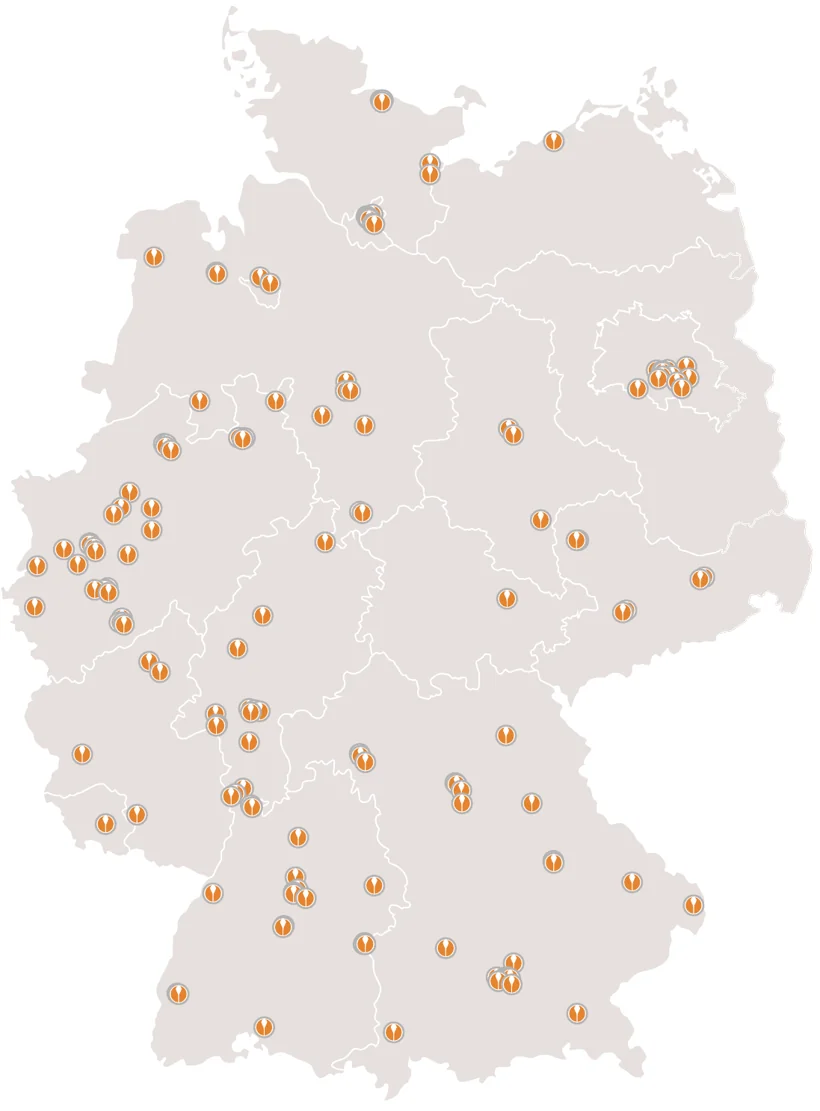
Almost all fertility centers in Germany are members and therefore supporters of the German IVF Register. On our website you will find all fertility centers that are members of the German IVF Register as a PDF download or as a direct search.
Find a member center near youD·I·R® certificate and D·I·R® signet 2026/2027

You can also recognize a fertility center that is a member of the German IVF Register by the fact that it has a current D·I·R® certificate and a D·I·R® signet.
Authors, responsible persons, imprint
German IVF-Registry (D·I·R)
Vorstandsvorsitzender
Dr. med. Andreas Tandler-Schneider
Board
Dr. med. Andreas Tandler-Schneider
Prof. Dr. med. Jan-Steffen Krüssel
Dr. med. Sascha Tauchert
Kuratorium
Dr. med. Sylvia Bartnitzky
Dipl.-Biol. Verona Blumenauer
Dr. med. Ute Czeromin (co-opted member)
Dr. med. Daniel Fehr
Dr. med. Christoph Grewe (co-opted member)
Prof. Dr. med. Markus S. Kupka
Prof. Dr. med. Nicole Singer
D·I·R® office and D·I·R® data management
Markus Kimmel · Kimmelnet
Lise-Meitner-Straße 14 · 40591 Düsseldorf
Tel.: +49 (0)211 913 84 800
E-mail: geschaeftsstelle@deutsches-ivf-register.de
www.deutsches-ivf-register.de
Graphics and layout
U&MI Design · Visual Communication
Dipl.-Des. Soo Hee Kim
E-mail: hello@uandmi.de
Copyright German IVF Register (D I R)® 2026
Online-Ergänzung
Wissen rund um die Kinderwunschbehandlung
Antworten auf häufige Fragen und die wichtigsten Begriffe aus dieser Sonderausgabe – kurz erklärt.
Häufige Fragen
Kurz beantwortet auf Basis der Registerdaten
Grundlagen
Was ist das Deutsche IVF-Register (D·I·R)®?
Das D·I·R® ist ein gemeinnütziger Verein, in dem nahezu alle Kinderwunschzentren in Deutschland freiwillig Mitglied sind. Es wertet die Behandlungsdaten dieser Zentren kontinuierlich aus – zur Qualitätssicherung, für die Forschung und für eine verlässliche Information von Paaren und Öffentlichkeit. Der Datenbestand umfasst inzwischen knapp 2,8 Millionen Behandlungen.
Woher stammen die Zahlen in dieser Sonderausgabe?
Aus den Behandlungsdaten der Mitgliedszentren. Für dieses Jahrbuch haben 138 von 141 Zentren ihre Daten zum Stichtag 28.04.2026 geliefert. 2025 wurden 139.907 Behandlungszyklen bei 71.629 Frauen dokumentiert. Die Zahlen bilden damit die Versorgung in Deutschland nahezu vollständig ab.
Warum beziehen sich manche Zahlen auf 2025, andere auf 2024?
Ob eine Behandlung zu einer Geburt geführt hat, steht erst rund neun Monate später fest. Deshalb zeigt das Jahrbuch die Zyklusausgänge (z. B. Schwangerschaftsraten) des Jahres 2025 und die Schwangerschaftsausgänge (Geburten, Fehlgeburten) der Behandlungen aus 2024.
Was ist der Unterschied zwischen Schwangerschaftsrate und Geburtenrate?
Die Schwangerschaftsrate zählt klinische Schwangerschaften, also im Ultraschall bestätigte Schwangerschaften. Nicht jede davon führt zu einer Geburt, etwa wegen einer Fehlgeburt. Die Geburtenrate ist deshalb niedriger, aber für Paare die aussagekräftigere Zahl: 2024 lag sie im Frischzyklus bei 22,3 % pro Embryotransfer.
Chancen
Wie hoch sind die Chancen pro Embryotransfer?
Im Durchschnitt lag die Schwangerschaftsrate pro Embryotransfer 2025 im Frischzyklus bei 30,2 % und im Kryozyklus bei 31,5 %. Die Geburtenrate pro Transfer betrug 2024 im Frischzyklus 22,3 % und im Kryozyklus 22,7 %. Diese Durchschnittswerte hängen stark vom Alter der Frau ab.
Wie stark beeinflusst das Alter die Chancen?
Sehr stark. Frauen zwischen 30 und 34 Jahren haben pro Embryotransfer eine Schwangerschaftschance von 39,0 % und eine Geburtenrate von 31,1 % (Frisch- und Auftauzyklen). Bei Frauen zwischen 41 und 44 Jahren sinken diese Werte auf 16,9 % und 8,9 %. Ab 40 hat jedes Lebensjahr großen Einfluss; auch das Risiko einer Fehlgeburt steigt deutlich. Werte für jedes Altersjahr
Wie viele Versuche braucht es bis zur Schwangerschaft?
Das ist individuell sehr verschieden. Die Registerdaten zeigen aber: Nach zwei Embryotransfers sind 53,7 % der Patientinnen schwanger, nach drei Transfers 64,9 % und nach vier Transfers 70,8 %. Ein negativer Test nach dem ersten Transfer ist also kein Grund aufzugeben. Cumulative pregnancy rates
Was sagt mein AMH-Wert über meine Chancen?
Der AMH-Wert zeigt die Eizellreserve. Je höher er ist, desto besser sind im Durchschnitt die Chancen; aber auch bei sehr niedrigem Wert (unter 0,25 ng/ml) wird noch etwa jede fünfte Frau nach einem Embryotransfer schwanger. Ein niedriger Wert bedeutet vor allem weniger Eizellen und häufiger keinen Transfer. Das Alter spielt mindestens eine ebenso große Rolle. Sonderthema AMH
Kann ich meine persönlichen Chancen selbst einschätzen?
Ja, mit dem ReproCheck des D·I·R®. Der kostenlose Online-Rechner schätzt auf Basis von über 600.000 Behandlungen aus den Jahren 2020 bis 2024 Ihre Chancen auf Schwangerschaft und Geburt – anhand von Alter, Vorgeschichte und Behandlungsart. Die Abfragen werden nicht gespeichert. Der ReproCheck ersetzt keine ärztliche Beratung, hilft aber, das Gespräch im Kinderwunschzentrum vorzubereiten. Mehr zum ReproCheck
Behandlung
Sollten ein oder zwei Embryonen eingesetzt werden?
Eine große Registerstudie mit über 22.000 Frauen zeigt: Werden zwei Embryonen gleichzeitig übertragen, entsteht nach dem ersten Transfer etwas häufiger eine Schwangerschaft. Wird zunächst nur ein Embryo eingesetzt und der zweite eingefroren, kommen über beide Transfers sogar etwas mehr Kinder zur Welt (45,6 % gegenüber 38,4 %) – bei weit weniger Mehrlingen (1,7 % gegenüber 30,3 %) und deutlich weniger Frühgeburten. Mehr zur Studie
Warum sind Zwillinge ein Risiko?
Mehrlingsschwangerschaften gehen mit deutlich höheren Risiken einher. 2024 kamen 87,8 % der Zwillinge und alle Drillinge zu früh zur Welt (vor Ende der 37. Schwangerschaftswoche), bei Einlingen waren es 17,0 %. Frühgeborene Kinder haben häufiger ein geringes Geburtsgewicht und brauchen öfter intensivmedizinische Betreuung; für die Mutter steigt das Risiko etwa für Bluthochdruck oder Präeklampsie.
Lohnt es sich, Embryonen oder Eizellen einzufrieren?
Ja. Die Erfolgsraten im Kryozyklus sind inzwischen mindestens so hoch wie im Frischzyklus. Nach nur einer Eizellgewinnung kann sich mehr als die Hälfte der Paare nach einem Frisch- und zwei Kryotransfers über ein Kind freuen. Für die Chancen zählt vor allem das Alter, in dem die Eizellen gewonnen wurden – lange Lagerung schadet nicht. Sonderthema Jung einfrieren
Übernimmt die Krankenkasse die Kryokonservierung?
Die Kryokonservierung und der anschließende Transfer gehören in Deutschland nach wie vor nicht zu den von den gesetzlichen Krankenkassen bezahlten Regelleistungen. Was in Ihrem Fall übernommen wird, klären Sie am besten mit Ihrem Kinderwunschzentrum und Ihrer Krankenkasse.
Was ist von Social Freezing zu halten?
Beim Social Freezing werden unbefruchtete Eizellen vorsorglich eingefroren. Die Erfolgsraten sind derzeit noch niedriger als mit eingefrorenen Embryonen. Ab 40 zeigt sich trotzdem ein Vorteil: 21 % Geburten pro Transfer mit Eizellen aus dem Alter von 30 bis 34 Jahren gegenüber 9 % im Frischzyklus. Diese Zahlen beruhen allerdings auf nur wenigen Hundert Behandlungen.
Wie sicher ist eine Kinderwunschbehandlung?
Die Verfahren gelten als sicher. Das Risiko einer Überstimulation als Folge der Hormontherapie lag zuletzt bei 0,3 %, Komplikationen der Eizellentnahme wie Blutungen bei 0,6 %. Das größere Risiko sind Mehrlingsschwangerschaften – deshalb setzen die Zentren zunehmend nur einen Embryo ein.
Kinderwunschzentrum
Wie finde ich ein Kinderwunschzentrum?
Auf deutsches-ivf-register.de finden Sie alle Mitgliedszentren als Liste zum Download oder über die Suche – nahezu alle Kinderwunschzentren in Deutschland sind Mitglied. Karte der Mitgliedszentren
Woran erkenne ich ein Mitgliedszentrum des D·I·R®?
Mitgliedszentren verfügen über ein aktuelles D·I·R® Zertifikat und das D·I·R® Signet 2026/2027. Sie nehmen an der Qualitätssicherung teil und sind Partner der Forschung des Deutschen IVF-Registers. Das D·I·R® empfiehlt, ein Zentrum zu wählen, das Mitglied ist und diese Jahrbücher möglich macht.
Wann sollten wir uns beraten lassen?
Möglichst früh, denn die Erfolgschancen sind altersabhängig. Gerade ab 35 Jahren – in dieser Gruppe befinden sich die meisten Patientinnen – sollte eine Behandlung zeitnah erfolgen. Lassen Sie sich in einem Kinderwunschzentrum beraten und entscheiden Sie dann gemeinsam.
Die Antworten geben Durchschnittswerte aus dem Deutschen IVF-Register wieder und ersetzen keine persönliche Beratung im Kinderwunschzentrum.
Glossar
Fachbegriffe von A bis Z
Kein passender Begriff gefunden.
- Abort
- Fehlgeburt: vorzeitiges Ende einer Schwangerschaft, bevor das Kind lebensfähig ist. Die Abortrate wird pro klinischer Schwangerschaft angegeben und steigt mit dem Alter deutlich an.
- AMH (Anti-Müller-Hormon)
- Hormon, das im Blut gemessen wird und Auskunft über die Eizellreserve gibt. Es hilft, die Erfolgsaussichten einzuschätzen und die Hormonstimulation zu planen. Angabe meist in ng/ml.
- Auftauzyklus
- Siehe Kryozyklus.
- Blastozyste
- Embryo im Entwicklungsstadium etwa am fünften bis sechsten Tag nach der Befruchtung. Blastozysten werden häufig für den Transfer oder das Einfrieren ausgewählt.
- Blastozystenkultur
- Verlängerte Kultivierung der Embryonen im Labor bis zum Blastozystenstadium. Sie erleichtert die Auswahl eines entwicklungsfähigen Embryos und damit den Transfer nur eines Embryos.
- DET (Double Embryo Transfer)
- Gleichzeitiger Transfer von zwei Embryonen in die Gebärmutter. Erhöht die Chance auf Mehrlinge deutlich.
- D·I·R®
- Deutsches IVF-Register e.V.: gemeinnütziger Verein, der die Behandlungsdaten nahezu aller deutschen Kinderwunschzentren auswertet und jährlich im Jahrbuch veröffentlicht.
- Eizellentnahme (Punktion)
- Gewinnung der Eizellen aus den Eierstöcken nach der Hormonstimulation, meist ultraschallgesteuert durch die Scheide.
- Eizellreserve
- Anzahl der in den Eierstöcken noch vorhandenen Eizellen. Sie nimmt mit dem Alter ab und lässt sich über den AMH-Wert abschätzen.
- Embryotransfer (ET)
- Übertragung eines oder mehrerer Embryonen in die Gebärmutter. Viele Raten im Jahrbuch werden „pro Embryotransfer“ angegeben.
- Extrauteringravidität (EUG)
- Schwangerschaft außerhalb der Gebärmutter, meist im Eileiter. Sie kann nicht ausgetragen werden.
- Fertilisation
- Befruchtung der Eizelle durch eine Samenzelle – bei IVF in der Kulturschale, bei ICSI durch Injektion einer Samenzelle in die Eizelle.
- Frischzyklus
- Behandlungszyklus, in dem Eizellen gewonnen, befruchtet und die entstandenen Embryonen im selben Zyklus übertragen werden.
- Frühgeburt
- Geburt vor Ende der 37. Schwangerschaftswoche. Bei Mehrlingen deutlich häufiger als bei Einlingen.
- Geburtenrate
- Anteil der Behandlungen bzw. Embryotransfers, die zur Geburt mindestens eines Kindes führen. Für Paare die aussagekräftigste Kennzahl.
- Hormonstimulation
- Medikamentöse Anregung der Eierstöcke, damit in einem Zyklus mehrere Eizellen heranreifen.
- ICSI
- Intrazytoplasmatische Spermieninjektion: Eine einzelne Samenzelle wird mit einer feinen Nadel direkt in die Eizelle eingebracht. Wird vor allem bei eingeschränkter Samenqualität eingesetzt.
- IVF (In-vitro-Fertilisation)
- Befruchtung „im Glas“: Eizellen und Samenzellen werden im Labor zusammengebracht, die Befruchtung erfolgt selbstständig.
- IVF/ICSI
- Kombination beider Verfahren im selben Behandlungszyklus: Ein Teil der Eizellen wird per IVF, ein anderer per ICSI befruchtet.
- Klinische Schwangerschaft
- Im Ultraschall bestätigte Schwangerschaft. Grundlage der Schwangerschaftsraten im Jahrbuch.
- Konfidenzintervall (95 %)
- Bereich, in dem der wahre Wert einer Rate mit 95-prozentiger Wahrscheinlichkeit liegt. Je weniger Behandlungen einer Rate zugrunde liegen, desto breiter ist das Intervall.
- Kryokonservierung
- Einfrieren von Eizellen, befruchteten Eizellen oder Embryonen in flüssigem Stickstoff, um sie später zu verwenden.
- Kryozyklus (Auftauzyklus)
- Behandlungszyklus, in dem zuvor eingefrorene Eizellen oder Embryonen aufgetaut und übertragen werden – ohne erneute Stimulation und Eizellentnahme.
- Kumulative Schwangerschaftsrate
- Anteil der Patientinnen, die nach mehreren Transfers insgesamt schwanger geworden sind – unabhängig davon, ob frisch oder nach Auftauen übertragen wurde.
- Mehrlingsrate
- Anteil der Geburten mit Zwillingen, Drillingen oder mehr Kindern an allen Geburten.
- Präeklampsie
- Schwangerschaftserkrankung mit Bluthochdruck und Beteiligung weiterer Organe; tritt bei Mehrlingsschwangerschaften häufiger auf.
- Prospective data
- Daten, die bereits während der laufenden Behandlung erfasst werden, bevor das Ergebnis feststeht. Sie gelten als besonders verlässlich.
- Prozentpunkt
- Differenz zwischen zwei Prozentwerten. Sinkt eine Rate von 22,0 % auf 6,7 %, ist das ein Rückgang um 15,3 Prozentpunkte.
- ReproCheck
- Kostenloser Online-Rechner des D·I·R®, mit dem Paare ihre Chancen auf Schwangerschaft und Geburt auf Basis von Registerdaten selbst einschätzen können.
- Retrospektive Daten
- Daten, die erst nach Abschluss der Behandlung erfasst werden.
- SET (Single Embryo Transfer)
- Transfer nur eines Embryos. Bei „SET + SET“ wird ein zweiter, eingefrorener Embryo später übertragen, falls keine Geburt erfolgt ist. Senkt das Mehrlingsrisiko erheblich.
- Social Freezing
- Vorsorgliches Einfrieren unbefruchteter Eizellen ohne aktuellen medizinischen Anlass, um sie später nutzen zu können.
- SSW (Schwangerschaftswoche)
- Zählweise der Schwangerschaftsdauer, gerechnet ab dem ersten Tag der letzten Regelblutung.
- Überstimulation (OHSS)
- Überreaktion der Eierstöcke auf die Hormonstimulation. Zuletzt bei 0,3 % der Behandlungen.
- Vitrifikation
- Ultraschnelles Einfrierverfahren, das die Bildung von Eiskristallen verhindert. Hat die Ergebnisse nach dem Auftauen deutlich verbessert.
- Zyklus (Behandlungszyklus)
- Eine Behandlung von Beginn (Stimulation bzw. Auftauen) bis zum Ergebnis. Das Jahrbuch zählt Zyklen und behandelte Frauen getrennt.
Erfolg ist für uns die Entstehung einer Einlingsschwangerschaft mit gesunder Mutter und gesundem Kind.
 EN
 DE